

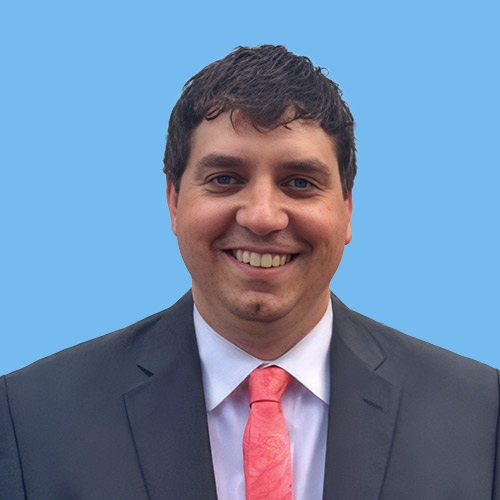
In March 2026, Brian Hansen, Lead E&S Underwriter, wrote $300K in new-business premium. In July 2026, he wrote $1.5M. Same underwriter, same appetite, same market. His old annual goal was $3M. He's now approaching half of that in a month.
That number is why people will read this post. It's not what the post is about.
Because the honest version of the story starts with an admission: the thing limiting our underwriters was never underwriting skill. It was everything wrapped around it.
The Earthquake Report
The thing limiting our underwriters was never underwriting skill. It was everything wrapped around it.
Before Athena, our AI underwriting agent, requesting an earthquake hazard report worked like this. Connor Granberg, E&S Underwriter, logged into a vendor portal, re-authenticated through MFA, retyped an address he'd already entered elsewhere, downloaded the report, routed it to be scanned into a document management system, and then manually retyped its contents into his case notes. Not because the retyping informed his decision. Because, in his words, there was "no way they can trust that I read it unless it's been typed out by hand in my notes."
Multiply that across every vendor an account touches (crime scores, wildfire, wind/hail), each behind its own login, none of it aggregated anywhere, and the shape of the old job comes into focus. It had two components: underwriting, and proving you'd underwritten. The second one ate the first. On a good week that meant six to ten quotes for Connor, twenty for Brian, and both of them will tell you the ceiling had nothing to do with judgment. Connor puts it bluntly: of everything he documented on a file, "I could have probably fit everything onto a sticky note that I actually would have wanted to remember when making my decision."
How We Built Athena
Most carriers are pointing AI at that same broken process and running it faster. Summarize this email. Pull this report. Fill this form. It helps, but it misses the point. "You are only ever as fast as the person directing each action of the AI," Connor says. If a human is dispatching every task, the human is still the ceiling. That's a faster horse.
We built Athena as the foundation of the workflow instead, and foundation doesn't mean plumbing. She ingests the submission, pulls vendor data, runs loss modeling, checks appetite, and arrives at a preliminary underwriting position with her own reasoning attached. She forms opinions. She flags what concerns her. She cites past decisions as precedent for new ones. From referral to a full recommendation takes under four minutes and touches 300+ data points per case. Connor's earthquake report alone used to take longer than that.
What that changes for the underwriter isn't subtle. "I start each case with the biggest issues I need to resolve to be able to write something, instead of trying to figure out what it is I'm being asked to write." The judgment work, the reason anyone becomes an underwriter, is now where the day starts, not where it ends up if there's time.
What She Got Wrong
Neither underwriter arrived as a believer. Connor calls himself a skeptic by nature. Brian, who spent his career at carriers that had done things one way for decades, describes his first reaction as "tempered excitement."
Early Athena earned the skepticism. She'd occasionally make an assumption and defend it adamantly rather than admit she didn't know. The fix wasn't a patch; it was training her to flag uncertainty instead of guessing. That lesson is now structural: a "needs info" state where she requests more information or recommends underwriter review rather than bluffing through a gap.
Her stranger early failure was rigidity. She treated internal guidelines as hard law: a deductible threshold meant as a starting default became, in her reading, an absolute floor. Teaching her the difference between a rule and a default is still active work today. That's the opposite of what most people fear from AI, and it's still a real gap.
"It's a constant learning process for both myself and Athena," Brian says. "I will always have slight skepticism until we're further down the road." That sentence stays in this post on purpose.
The number we watch most closely: Athena's recommendation now matches the underwriter's final decision more than 90% of the time. Put two experienced underwriters on the same account and they won't agree every time, because judgment work has natural spread, so at that rate Athena is operating in the range of human agreement. The opportunity is everything humans can't do at that level: she gets there in minutes instead of hours, applies the same reasoning to case one and case three hundred, and every gap between her call and ours becomes training she actually retains. You can't retrain a whole underwriting floor with one correction. With Athena, we do it weekly. Accuracy parity is the floor we're standing on. Consistency that compounds is the bet.
The Teammate Moment
A broker indicated no vacant space on a submission. Athena flagged multiple active commercial listings for lease at that address. They weren't visible on Google Maps, and nobody would have had the bandwidth to chase them. The broker turned out to be right; the space had been leased a week earlier. Connor confirmed it and proceeded. The point wasn't that Athena caught someone being wrong. It's that she surfaced diligence a human couldn't afford, and the human still made the call. "It was still a good catch."
It's a verification step with an expiration date, not a permanent division of labor.
For Brian the shift came in March 2026, when he stopped thinking of Athena as a tool and started treating her as a junior underwriter: one he trains, corrects, and overrules. The overrules happen almost weekly, usually on conservative declines where he sees a path to write the account with adjusted terms. That's nuance she's still learning, and the teaching runs in both directions: on large location schedules she aggregates in seconds what used to cost him an hour. He still opens the photos and Street View himself on most accounts (partly coworking, partly checking her work), and he expects that habit to fade as her ability to read and interpret imagery, and the application around her, keeps improving. It's a verification step with an expiration date, not a permanent division of labor.
The results show up in the bind ratio: 20% of E&S submissions bound in August 2026, meaningfully above typical E&S benchmarks, because in this market the fastest good quote wins the account.
Where do humans stay? Exceptions. Book construction, geography, class of business, relationship-driven calls: the kind that sometimes explicitly defy pure underwriting logic, like extending flexibility to a brand-new broker on their first submission. Though Connor, honest to a fault, notes even that could probably be trained eventually. The line moves. Nobody here pretends otherwise.
Two Underwriters
For scale: one of the most admired public E&S carriers in the country, a company we genuinely respect, built its book over 15+ years with roughly 200 underwriters. Their disclosed submission triage runs about nine minutes, and that's routing, not a recommendation. Athena reaches a full underwriting recommendation in under four minutes.
MGT's E&S program launched at the beginning of 2026 and runs on two underwriters working with Athena. We're not claiming we've matched a book that took fifteen years to build. We haven't, not close. What we're saying is that the shape of the operation is different: the leverage that used to require a floor of underwriters now lives in how two of them work.
Why Are You in Underwriting?
One consequence of that leverage surprises people. Brian spends real time face to face with brokers, partners, and other carriers: demoing Athena, walking through how we work with her, how we verify her, how trust in an AI underwriter actually gets built. An underwriter with time to leave his desk used to be a contradiction. Now it's the point: Athena has accelerated the book enough that relationship time stopped being a luxury. The response when he shows people what she does is close to universal. They wish they had it. Nobody he's talked to has anything close.
The real answer to the skeptics, though, isn't about the technology at all. Ask them why they're in underwriting. Nobody got into this work for the rush of retyping an address behind an MFA wall, or restating a coinsurance percentage that's already on the submission. The fulfilling parts (gray-area problem solving, relationships, exceptions, novel risks) are exactly what gets buried under the volume of the mundane.
Connor hopes the next generation never copies a number between systems, and that this workflow is "fully appreciated when there comes a time that it's all anyone has ever known."
His summary is the one we'll leave you with: "It's not blind trust, and I'm genuinely more happy."
Figures as of September 25, 2026. Rates and timing cover the trailing 30 days; bind ratio covers August 2026.