Commercial Property
Covers the building a business owns or the improvements it made to leased space, plus equipment, inventory, furniture, and other business personal property, when a covered cause such as fire or theft damages them.
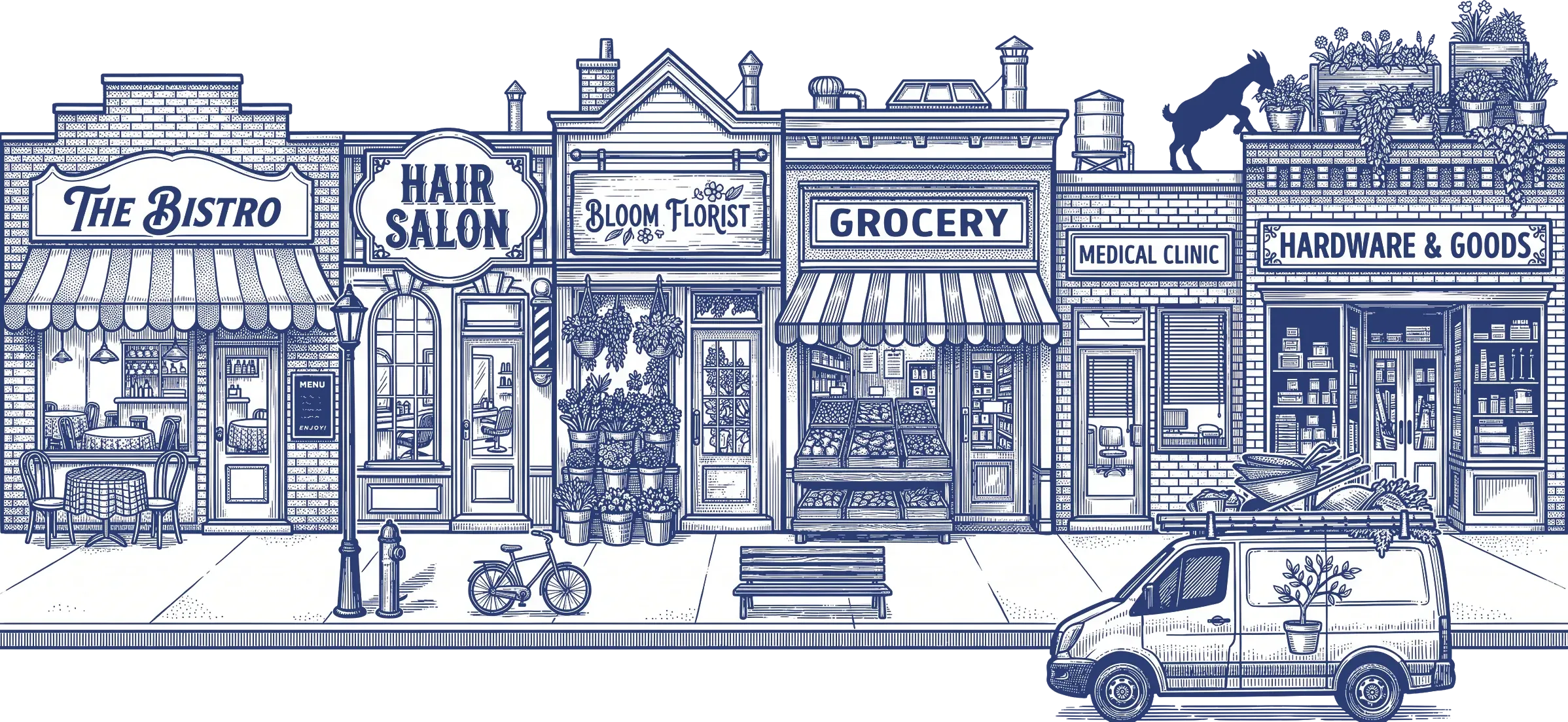
A Business Owner's Policy (BOP) combines commercial property, general liability, and business income coverage in one policy for eligible small businesses. MGT's BOP includes cyber liability by default and is available only through independent agents, who can tailor it with optional coverages such as equipment breakdown.
Last updated
Every MGT BOP packages three core coverages, and cyber liability is included by default.
Covers the building a business owns or the improvements it made to leased space, plus equipment, inventory, furniture, and other business personal property, when a covered cause such as fire or theft damages them.
Pays to defend and settle third-party claims for bodily injury, property damage, and personal and advertising injury arising from the business’s premises and operations.
Replaces lost income and helps pay continuing expenses while the business is closed for repairs after covered physical damage.
Included by default in MGT’s BOP. The policy documents set its specific terms and limits.
Terrorism coverage, and mine subsidence where it applies, are included by default and can be declined.
Agents can tailor an MGT BOP with these options. Some are included by default for eligible classes and can be removed; others are added as needed. Availability depends on the class of business and the state.
Included by default for restaurants
Adds coverages including food contamination and restaurant spoilage. Coverage for loss or damage to customers’ autos can be added.
Included by default for artisan contractors
Covers materials waiting to be installed and the contractor’s own tools and equipment. Coverage for employees’ tools and borrowed or rented tools can be added.
Optional
Covers sudden mechanical or electrical breakdown of equipment such as refrigeration, HVAC systems, and ovens.
Optional
Covers liability when employees drive rented or personal vehicles for the business. Available for restaurants and other eligible classes.
Optional
Responds to claims tied to the employment relationship, such as allegations of discrimination or wrongful termination.
Businesses that sell or serve alcohol
Covers liability that arises from selling or serving alcohol, such as a claim after an intoxicated customer injures someone. Available for eligible restaurants, including wine bars and brewpubs, as well as convenience stores, grocery stores, and liquor, beer, and wine retailers. Availability depends on the class and state.
Some classes
Available for eligible classes, such as barber shops, hair and nail salons, optical and hearing aid businesses, and veterinarians.
Optional
Covers claims from mistakes in administering employee benefit programs, such as failing to enroll an employee in a health plan.
States with state-fund workers’ compensation
Adds employer’s liability coverage for businesses in states where workers’ compensation is available only through a state fund.
Each location
Can be listed for each location, such as a landlord whose lease requires it, with an optional waiver of subrogation for each.
Businesses with perishable stock
Covers perishable stock that spoils after a covered event, such as a refrigeration breakdown. Available for eligible classes such as grocers, florists, and pharmacies. Restaurants get it through the restaurant package.
Businesses that sell food
Covers lost income and cleanup costs if a health authority closes the business because of food contamination. Restaurants get this through the restaurant package.
Optional
After a covered loss, covers the cost to demolish undamaged parts of a building and rebuild to current code, plus the lost value of the undamaged portion.
Optional
Covers money, securities, or property lost to theft or fraud by an employee.
Optional
Covers cash, checks, and securities lost to theft, destruction, or disappearance, on the premises or in transit.
Optional
Covers expenses for owners who become victims of identity theft, such as legal fees and lost wages.
Also available: outdoor signs, fine arts, brands and labels, reward payment, and lock replacement.
Not available on MGT’s BOP: utility service interruption coverage.
A BOP is built for the property and liability risks most small businesses share, so several large exposures sit outside it.
MGT doesn’t currently write workers’ compensation, commercial auto, flood, or earthquake coverage, so agents place those lines separately. For the full list of gaps and the fix for each, read the MGT blog post What a BOP Does (and Doesn’t) Cover
Two everyday losses, and the parts of a BOP that may apply to each.
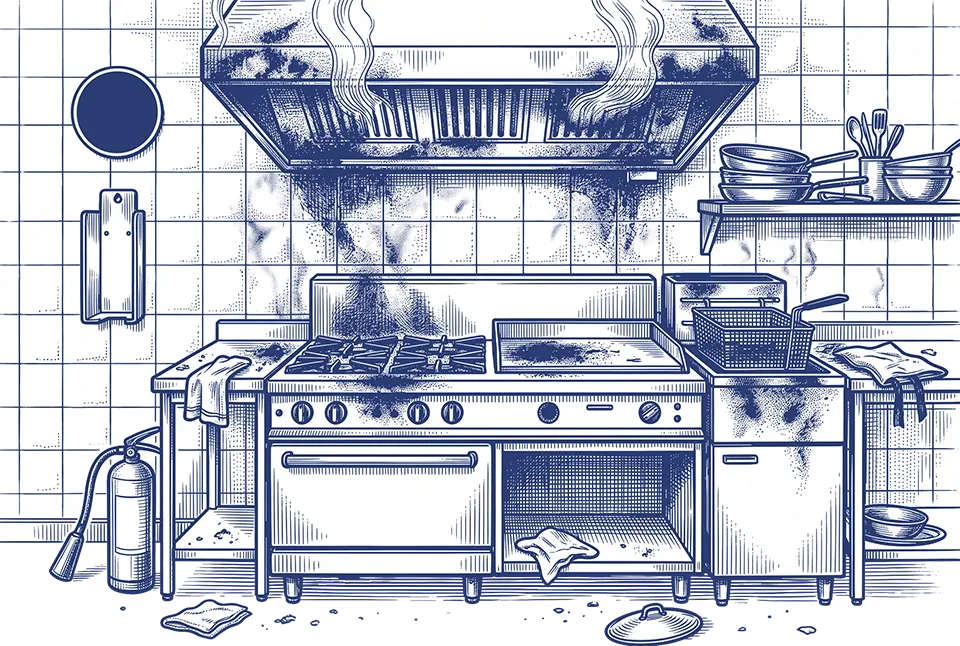
Restaurant
A grease fire damages the kitchen and the restaurant closes for repairs.
Applicable CoverageCommercial property for the damaged equipment and improvements, and business income for income lost while closed.
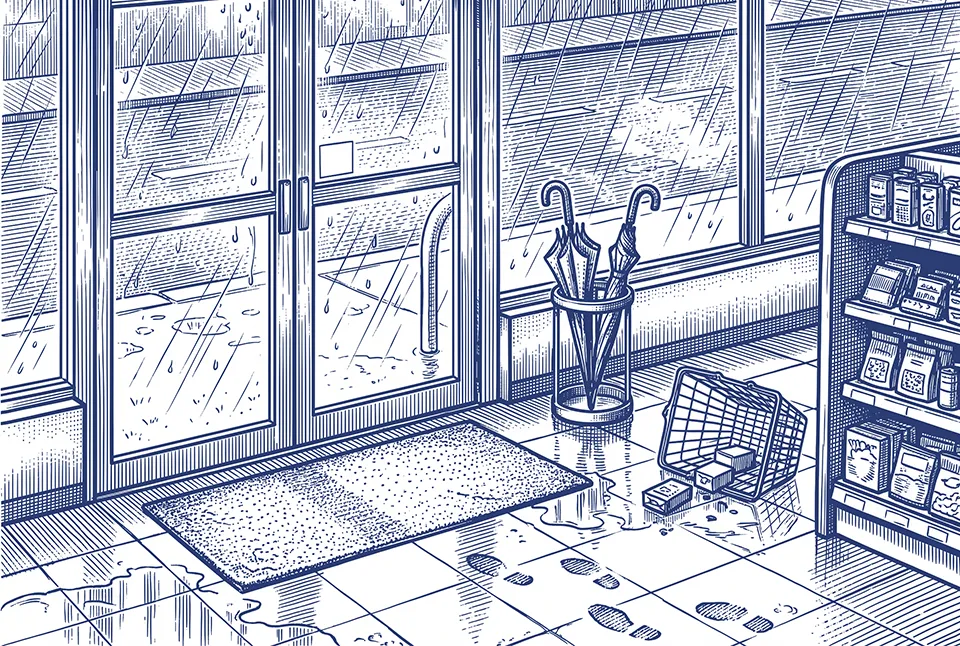
Retail store
A shopper slips on a wet floor, is injured, and files a claim against the store.
Applicable CoverageGeneral liability for the injury claim and the cost to defend it, plus medical expense coverage for the shopper’s medical bills regardless of fault.
These examples are illustrations. Whether coverage applies depends on the policy’s terms, conditions, limits, and exclusions.
MGT writes BOPs for a wide range of small commercial businesses, including these categories. Each tile opens that category’s coverage guide (PDF). Check current eligibility by class and state on the appetite page before quoting.
Want every class guide in one place? Open the MGT Coverage Guide (PDF)
Appointed agents go from appetite check to bound policy in four steps.
Look up the class and state on the appetite page, or ask Aimee, MGT’s AI quoting assistant.
Quote in the MGT portal, upload a document, or quote in chat with Aimee.
Every quote is checked against MGT’s appetite and underwriting rules, and some quotes are referred to an MGT underwriter for review.
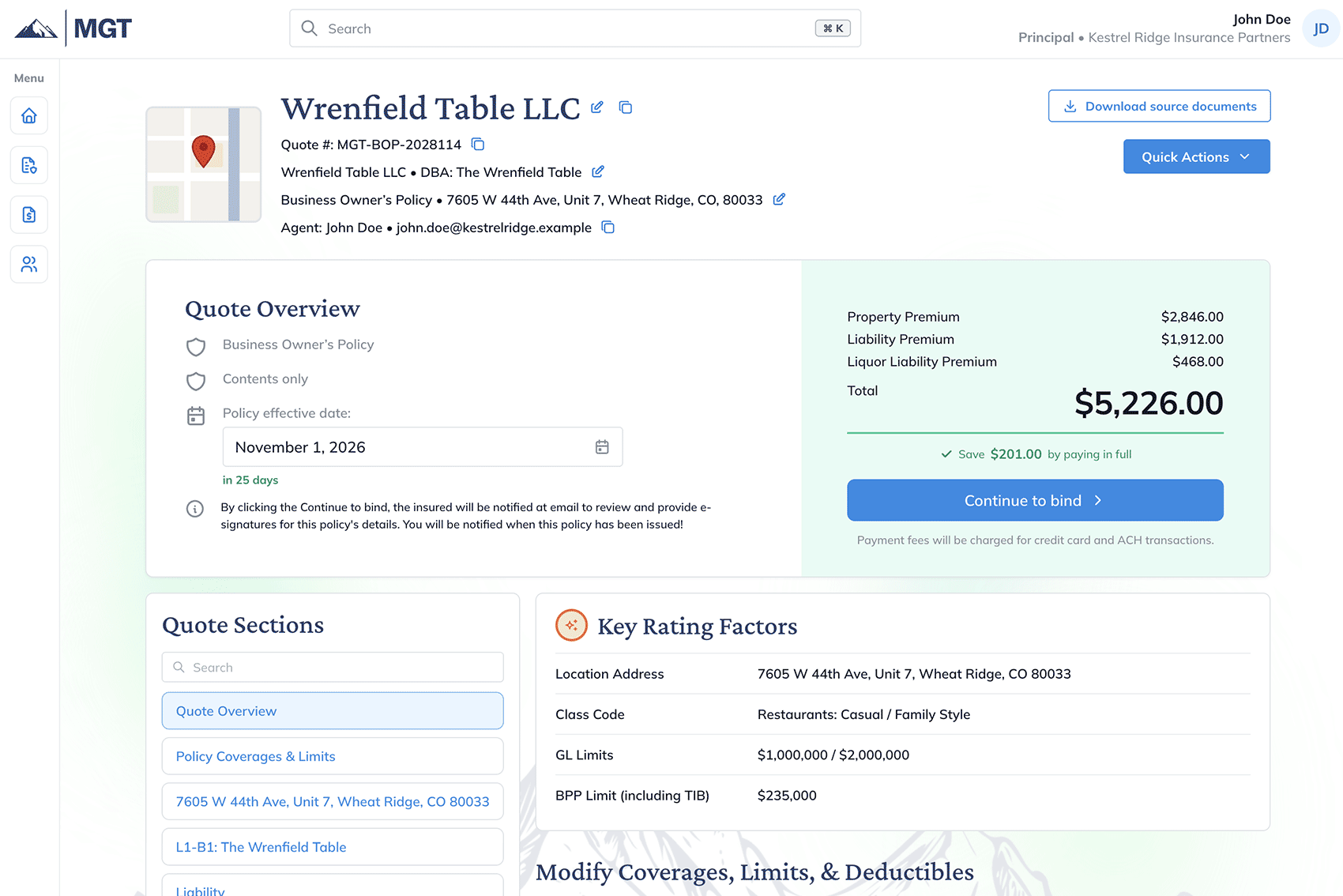
Every quote opens in the MGT portal for review before binding, including quotes started in chat.
Quotes are based on the information the agent provides and are subject to MGT’s underwriting rules. Whichever way you start, the quote asks about:
Not appointed yet? Get appointed, or work with MGT through one of its partners.
A BOP packages property, liability, and business income for eligible small businesses. Standalone general liability covers only third-party claims. A commercial package policy combines individually selected coverage parts for larger or more complex risks. MGT writes the BOP.
| Feature | BOPBusiness Owner’s Policy | GLGeneral Liability | CPPCommercial Package Policy |
|---|---|---|---|
| Property Coverage | Included | Not included | Available when selected |
| Liability Coverage | Included | Included | Available when selected |
| Business Income | Included | Not included | Available when selected |
| Typical Fit | Eligible small businesses with property to protect | Businesses with little property, or that don’t qualify for a BOP | Larger or more complex businesses, or risks outside BOP eligibility |
| How Coverage Is Set | A prepackaged core with optional endorsements | Liability coverage with optional endorsements | Each coverage part selected and rated separately |
| Eligibility | Limited by class, size, and each carrier’s rules | Widely available across classes | Broad, for risks that need more flexibility |
For a deeper comparison to share with clients, read the MGT blog post BOP vs. General Liability: Which Does a Small Business Need?
MGT calculates each BOP premium from its filed rates and rating rules, so premiums vary from account to account. The main factors are:
To see pricing for a specific account, start a quote.
Agents place BOPs with MGT Insurance, a leading AI-native neo-insurer for small commercial property and casualty, built from the ground up for independent agents. MGT’s rates and eligibility rules follow its filed rate plans.

MGT holds an A- (“Excellent”) financial strength rating from AM Best. Read the AM Best announcement
AM Best rating of A- (Excellent) as of April 6, 2026, assigned to MGT Insurance Company. Ratings are under continuous review and subject to change; for the latest rating, visit www.ambest.com. The rating reflects the insurer’s overall financial strength and is not a recommendation of any specific policy provisions, rates, or practices.
To tailor a BOP to a client’s operations, read the MGT blog post How to Customize a BOP for Your Client’s Specific Business

MGT’s BOP is available only through independent insurance agents, and MGT doesn’t sell policies directly to business owners. To ask about coverage from MGT, contact your independent agent and ask whether MGT’s Business Owner’s Policy fits your business.
A Business Owner's Policy (BOP) is a package policy that combines commercial property, general liability, and business income coverage for eligible small businesses. Bundling these coverages in one policy is simpler than buying each one separately. MGT builds its BOP on ISO's standard coverage form, includes cyber liability by default, and offers it only through independent agents.
MGT's BOP covers commercial property, general liability, and business income, and includes cyber liability by default. Every policy also builds in coverages such as water backup, accounts receivable, and electronic data. Depending on the class of business and the state, agents can add or adjust options including equipment breakdown, employment practices liability, liquor liability, employee dishonesty, ordinance or law, hired and non-owned auto, and packages for restaurants and contractors.
Yes. Cyber liability is included by default in MGT's BOP, so agents don't need to add it as a separate option. The policy documents set its specific terms and limits, and agents can review it in the MGT portal before binding, along with the rest of the quote. For questions about a specific risk, agents can ask Aimee, MGT's AI quoting assistant.
Yes, on eligible risks. Employment practices liability (EPLI) is optional, and hired and non-owned auto (HNOA) is optional on eligible classes, including restaurants. Availability depends on the class of business and the state, so check the appetite page or ask Aimee, MGT's AI quoting assistant, before quoting.
No. A BOP covers the business's own property and its liability to third parties, but injuries to the business's own employees fall under workers' compensation, which is a separate policy. MGT doesn't currently write workers' compensation, so agents place it with another carrier alongside the MGT BOP.
No law requires a business to carry a BOP itself. In some jurisdictions, though, businesses are required to carry liability insurance, which a BOP provides. Landlords, lenders, and clients also often require proof of property or liability coverage in a lease, loan, or contract, and a BOP is a common way to meet those requirements.
General liability covers only third-party claims for bodily injury, property damage, and personal and advertising injury. A BOP includes that liability coverage and adds commercial property and business income. For an eligible small business with property to protect, a BOP is usually the more complete option, while standalone general liability fits businesses with little property or that don't qualify for a BOP.
Appointed agents can quote in the MGT portal, upload a document, or quote in chat with Aimee, MGT's AI quoting assistant. Every quote is checked against MGT's appetite and underwriting rules, and some quotes are referred to an MGT underwriter for review. Every quote opens in the MGT portal for review before binding. Agents who aren't appointed yet can apply on the Get Appointed page
Policyholders can sign in to their MGT account to view and download policy documents and get certificates of insurance (COIs). They can also manage payments and track claims there. Their independent agent can help with certificates too, and MGT's customer service team is available through the chat on mgtinsurance.com.
A policyholder can report a claim by calling MGT's claims line at (800) 206-0960, by emailing the claims team, or through their independent agent, who can file on their behalf. Losses should be reported promptly. For what to have ready and what happens after a claim is reported, see the Claims FAQ
No. MGT offers its BOP only through independent insurance agents and doesn't sell directly to business owners. A business owner who wants coverage from MGT should contact their independent agent and ask whether MGT's BOP fits the business. The agent can check appetite, quote, and bind the policy.
This page summarizes MGT’s Business Owner’s Policy for independent agents and doesn’t change any policy. Coverage is not available in all states or for all classes of business. Refer to the policy for a complete list of covered losses, losses not insured, and policy exclusions.
Policies are underwritten by MGT Insurance Company (NAIC #16203).
Press coverage, webinars, and company news from MGT, plus first-person stories from the team building the first AI-native carrier.
Form Submitted Successfully

Next-generation, small business portal for ultra-fast BOP quoting, binding, and agent management
Legacy portal for Church Mutual, Religious Services, other Nonprofit business, and their policyholders